Niveau 6
Grade 6 Mathematics Tutoring
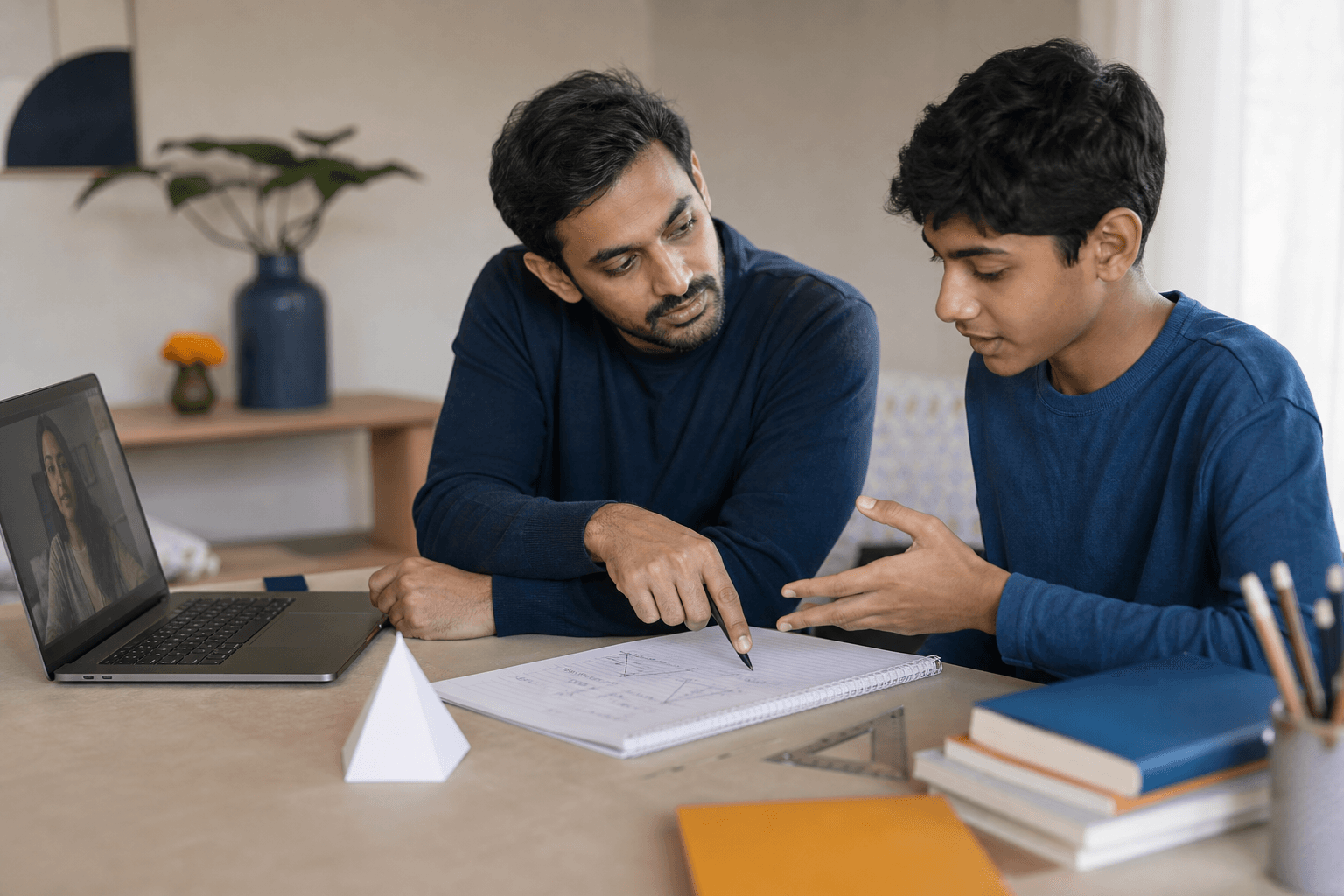
Live online Grade 6 maths in groups of five: sets, integers, ratio and rate, profit and loss, first algebra, linear equations, angles, mensuration and probability.
La réponse en bref
Grade 6 is the first year of middle school mathematics and the year letters start standing for numbers. It covers sets and Venn diagrams, integers, factors and multiples, ratio and rate, profit, loss and discount, algebraic expressions, linear equations, angles and parallel lines, mensuration, transformations and probability.
Ce que nous couvrons en Mathématiques au niveau 6
- Sets and Venn diagrams
- Integers and the number line
- Factors, multiples, HCF and LCM
- Ratio, rate and proportion
- Financial mathematics: profit, loss and discount
- Introduction to algebra: expressions and substitution
- Linear equations in one variable
- Angles, parallel lines and practical geometry
- Perimeter, area and volume (mensuration)
- Data handling and introduction to probability
À la fin de l'année
- Add, subtract, multiply and divide integers and apply the correct order of operations.
- Simplify simple algebraic expressions and solve a linear equation in one variable.
- Calculate the area of a triangle and a trapezium, and the surface area and volume of a cube and cuboid.
Là où les élèves bloquent
- Negative number arithmetic — especially subtracting a negative and multiplying two negatives.
- Reading '=' as 'the answer comes next' rather than as 'both sides balance', which breaks equation solving.
Negative numbers become arithmetic
Students have seen negative numbers as temperatures for years. Grade 6 asks them to calculate with them, and the two rules that cause the trouble are subtracting a negative and multiplying two negatives.
Rhymes about two minuses making a plus produce students who apply the rule to addition as well. We keep it on the number line for subtraction, where taking away a debt visibly moves you up, and treat the multiplication rule as a separate result with its own reasoning.
The equals sign changes meaning
For five years, = has meant 'write the answer here'. Every sum a primary student has met puts the working on the left and the result on the right, so the symbol acquires a direction it does not actually have.
Equation solving requires it to mean balance instead. A student holding the old meaning will do something to one side and not the other and see nothing wrong, and no amount of practice at solving equations fixes that until the sign itself is renegotiated.
Letters standing for numbers
Expressions, substitution and simplifying arrive this year, and this is the largest conceptual step in school mathematics. A student who has spent five years finding answers is now handling a quantity whose value is unknown and often does not need to be found.
Those who meet it as a new set of rules to memorise tend to stall within a year. Those who understand that a letter is a number whose name we do not know yet keep moving — and which of the two happens is largely decided by how this year is taught.
- Session length, up from 45 in primary
- 60 minSession length, up from 45 in primary
- Maximum students in a group
- 5Maximum students in a group
- Sessions a week
- 3–5Sessions a week
Questions fréquentes
What maths do Grade 6 students learn?
Sets and Venn diagrams, integers, factors, multiples, HCF and LCM, ratio and rate, profit, loss and discount, algebraic expressions and substitution, linear equations in one variable, angles and parallel lines, area and volume, transformations, data handling and probability.
Why does my child suddenly find maths hard in Grade 6?
Two reasons usually. Algebra is a genuine conceptual jump rather than more of the same, and negative number arithmetic breaks rules that have held since Grade 1. Neither means a student has stopped being capable, and both respond to explanation rather than to more of the same practice.
How long are Grade 6 maths classes?
60 minutes, three to five times a week, in groups of at most five. The step up from 45 minutes matches the longer reasoning the work now requires.
Sources
- Draft Single National Curriculum: Mathematics, Grades 6–8 — Ministry of Federal Education and Professional Training, Pakistan
- Cambridge Lower Secondary Mathematics curriculum — Cambridge Assessment International Education
- National curriculum in England: mathematics programmes of study — Department for Education
Dernière mise à jour
Essayez un cours gratuit de niveau 6
Un cours d'essai, donné par le professeur qui suivrait réellement votre enfant. Sans carte bancaire, sans engagement.